YOU CAN FINDOUT VARIOUS LEADERS IN THIS BLOG......

proud to be an INDIAN

proud to be an INDIAN

Search This Blog

Wednesday, July 27, 2011

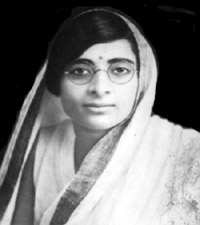
KAMLA NEHRU


Many women of the Nehru family too had joined the Civil Disobedience Movement. Kamala Nehru, Jawaharlal Nehru's wife gave full support to her husband in his desire to work actively for the freedom struggle. In the Nehru hometown of Allahabad she organized processions, addressed meetings and led picketing of liquor and foreign cloth shops. She played a prominent part in organizing the No Tax Campaign in United Provinces (now Uttar Pradesh).

Kamala Kaul Nehru (1899–1936) was the wife of Jawaharlal Nehru, leader of the Indian National Congress and first Prime Minister of India. Kamala married Nehru on 8 February 1916. Their marriage was arranged by his parents.

Brought up in a traditional Hindu Brahmin family, she felt alienated amongst the more Westernized Nehrus. It was only with the involvement of the Nehrus in the national movement, that she emerged into the forefront. In the Non Cooperation movement of 1921, she organized groups of women in Allahabad and picketed shops selling foreign cloth and liquor. When her husband was arrested to prevent him delivering a "seditious" public speech, she went in his place to read it out. She was twice arrested by British authorities.

Described as pretty, slim, and tender, Kamala was quiet, unobtrusive, and is thought to have had little impact on her husband. In 1917, she gave birth to a daughter, Indira Priyadarshini, who later succeeded her father as prime minister and head of the Congress party. Kamala died from tuberculosis in Switzerland while her husband was in prison.

She spent some time at Gandhi's ashram with Kasturba Gandhi where she built a close friendship with Prabhavati Devi wife of Jayaprakash Narayan.

Wednesday, July 20, 2011

BHIKAJI CAMA


Born: 24 September 1861
Bombay, India

Died: 13 August 1936 (aged 74)

Bhikaji Cama, also known as Madam Cama, was an outstanding lady of great courage, fearlessness, integrity, perseverance and passion for freedom. Madam Bhikhaji Cama was a pioneer amongst those who martyred their lives for India’s freedom and was considered the mother of Indian Revolution.

Cama was born on September 24, 1861 in a rich Parsi family at Bombay. She had her early education from Alexandra Native Girl’s English Institution and was open to learn all languages. She got married to a British lawyer Rustom Cama in 1885 but unfortunately they were poles apart and she involved herself in various social activities.

In 1896, Bombay Presidency was adversely hit by plague. Being a nationalist and a social worker Cama voluntarily worked for the victims of plague and at the end she herself was caught by the disease. She was saved but became very weak and was advised to go to Europe for rest and further treatment. In 1902 she left for London and there too she worked for promoting India’ freedom struggle. For some time, she worked as private secretary to Dadabhai Navaroji, a great Indian leader.

She was constantly making people realize the importance of freedom from British rule. Britishers unpleased with her popularity concocted an assassination but fortunately Cama came to know about the planned murder and escaped to France.

In France, she made her house a secret shelter for revolutionaries around the world. She was constantly helping revolutionaries by sending materials and money across the seas as and when required. As the British saw her influence they requested French Government to send her back but the request was refused. In return, the Britishers exiled Cama from her motherland.

In 1905, Cama along with her friends designed the India’s first tricolor flag with green, saffron and red stripes bearing the immortal words – Bande Matram. This flag was raised by Madam Cama On August 22, 1907, for India's Independence at the International Socialist Conference in Stuttgart, Germany. After 35 years fighting for India’s independence on foreign land she returned to India and died on August 13, 1936.

KHUDIRAM BOSE


Born:December 3, 1889 in the village Medinipur of Bengal.

He was one among the youngest revolutionaries of India’s freedom struggle.

Khudiram had always lived a virtuous and generous life. Since childhood he was fond of the sacred words of Vande Matram and in later years got inspired by the notions of karma and norms of Bhagvad Gita. During the partition of Bengal, discontent and anger against the Britishers compelled him to get involved in revolutionary activities. He was resolved to free India from the rule of British Empire. To learn more about the revolutionaries and their activities he joined Jugantar – the party of revolutionaries.

Bose, at the age of 16, threw the first bomb over the British who were crushing India. He had planted these bombs near the police station where many officials were killed. Further, he was arrested for placing a series of bomb but that was not the end. He along with his friend again planned to throw a bomb to assassinate the Chief Presidency Magistrate Kingsford who was known to make brutal and blatant judgments against freedom fighters.

Khudiram was arrested on the charges of bomb attack and was sentenced to death on August 11, 1908. He died with the holy book Bhagwad Gita in his hands and amiling with the slogan Vande Matram on his lips.


Tuesday, July 19, 2011

Jinnah Mohamed Ali


Born :-December 25, 1876
Karachi, Bombay
EXPIRED:-September 11, 1948 (aged 71)
Karachi, Dominion of Pakistan
Jinnah was born Mohamed ali Jinnahbhai (Gujarati: મુહમ્મદ અલી જિન્નાભાઈ) in Wazir Mansion Karachi. Sindh had earlier been conquered by the British and was subsequently grouped with other conquered territories for administrative reasons to form the Bombay Presidency of British India. Although his earliest school records state that he was born on October 20, 1875, Sarojini Naidu, the author of Jinnah's first biography, gives the date as ”December 25, 1876”.
Jinnah was the first child born to Mithibai and Jinnahbhai Poonja. His father, Jinnahbhai (1857–1902), was a prosperous Gujarati merchant who hailed from the state of Gondal situated in the Kathiawar region province of Gujrat (present day India). He had moved to Karachi from Kathiawar, because of his business partnership with Grams Trading Company whose regional office was set up in Karachi, then a part of the Bombay presidency. He moved to Karachi some times before Jinnah's birth.His grandfather, Poonja Gokuldas Meghji,was a Hindu Bhatia Rajput from Paneli village in Gondal state in Kathiawar. Jinnah's ancestors were Hindu Rajputs; his grandfather had converted to Islam.Jinnah's family belonged to the Ismaili Khoja branch of Shi'a Islam, though Jinnah later converted to Twelver Khoja Shi'a Islam.
The first-born Jinnah was soon joined by six siblings; three brothers - Ahmad Ali, Bunde Ali, and Rahmat Ali - and three sisters - Maryam, Fatima and Shireen. Their mother language was Gujarati; in time they also came to speak Kutchi, Sindhi and English. The proper Muslim names of Mr. Jinnah and his siblings, unlike those of his father and grandfather, are the consequence of the family's immigration to the predominantly Muslim state of Sindh.
Jinnah was a restless student and studied at several schools: first at the Sindh-Madrasa-tul-Islam in Karachi; then briefly at the Gokal Das Tej Primary School in Bombay; and finally at the Christian Missionary Society High School in Karachi, where, at age sixteen, he passed the matriculation examination of the University of Bombay.

rare photographs of great and giant legends

JAWAHARLAL NEHRU


Thursday, July 7, 2011

Binding and Non-binding Agreements for Personal Relating


I am just wondering if anyone has heard of a non-binding agreement for personal relating?

For example a binding agreement for personal relating is called marriage or the more technical term is
a "Bucketloads Agreement". Why Bucketloads? Because if the agreement is broken it costs the guy bucketloads upfront and it costs the woman buckoads over the following 20 years.

I think that there are only 2 types of recognised agreements for personal relating at present and they are the polar ends of each other.

A personal relating free for all
ie. " Don't fuss with me!"
A binding agreement for personal relating or Marriage.
ie. "Bring bucketloads of cash with you!"

I am proposing a new non-binding agreement for personal relating that falls in between these two.
I call it

Rethink Perfect - A non-binding agreement for personal relating
ie. "Feedback is always worth reconsidering"

I am in the process of documenting this non-binding agreement that has taken me 25 years so far to consider at http://rethinkperfect.com I have the rough outline of 9 chapters any feedback would be greatly appreciated.


Don’t get me wrong there is no getting away for the leagal ramifications of having a child in a personal relationship.
I just think crafting a non-binding agreement before this occurs can prepare people for this binding agreement instead of being thrown into the deep end going from a personal relating free for all, to the binding agreement for personal relating.

Tuesday, February 16, 2010

Dr. B.R. Ambedkar


Born: April 14, 1891
Died: December 6, 1956
Achievements: Dr. B.R. Ambedkar was elected as the chairman of the drafting committee that was constituted by the Constituent Assembly to draft a constitution for the independent India; he was the first Law Minister of India; conferred Bharat Ratna in 1990.

Dr. B.R. Ambedkar is viewed as messiah of dalits and downtrodden in India. He was the chairman of the drafting committee that was constituted by the Constituent Assembly in 1947 to draft a constitution for the independent India. He played a seminal role in the framing of the constitution. Bhimrao Ambedkar was also the first Law Minister of India. For his yeoman service to the nation, B.R. Ambedkar was bestowed with Bharat Ratna in 1990.

Dr.Bhimrao Ambedkar was born on April 14, 1891 in Mhow (presently in Madhya Pradesh). He was the fourteenth child of Ramji and Bhimabai Sakpal Ambavedkar. B.R. Ambedkar belonged to the "untouchable" Mahar Caste. His father and grandfather served in the British Army. In those days, the government ensured that all the army personnel and their children were educated and ran special schools for this purpose. This ensured good education for Bhimrao Ambedkar, which would have otherwise been denied to him by the virtue of his caste.

Bhimrao Ambedkar experienced caste discrimination right from the childhood. After his retirement, Bhimrao's father settled in Satara Maharashtra. Bhimrao was enrolled in the local school. Here, he had to sit on the floor in one corner in the classroom and teachers would not touch his notebooks. In spite of these hardships, Bhimrao continued his studies and passed his Matriculation examination from Bombay University with flying colours in 1908. Bhim Rao Ambedkar joined the Elphinstone College for further education. In 1912, he graduated in Political Science and Economics from Bombay University and got a job in Baroda.

In 1913, Bhimrao Ambedkar lost his father. In the same year Maharaja of Baroda awarded scholarship to Bhim Rao Ambedkar and sent him to America for further studies. Bhimrao reached New York in July 1913. For the first time in his life, Bhim Rao was not demeaned for being a Mahar. He immersed himself in the studies and attained a degree in Master of Arts and a Doctorate in Philosophy from Columbia University in 1916 for his thesis "National Dividend for India: A Historical and Analytical Study." From America, Dr.Ambedkar proceeded to London to study economics and political science. But the Baroda government terminated his scholarship and recalled him back.

The Maharaja of Baroda appointed Dr. Ambedkar as his political secretary. But no one would take orders from him because he was a Mahar. Bhimrao Ambedkar returned to Bombay in November 1917. With the help of Shahu Maharaj of Kolhapur, a sympathizer of the cause for the upliftment of the depressed classes, he started a fortnightly newspaper, the "Mooknayak" (Dumb Hero) on January 31, 1920. The Maharaja also convened many meetings and conferences of the "untouchables" which Bhimrao addressed. In September 1920, after accumulating sufficient funds, Ambedkar went back to London to complete his studies. He became a barrister and got a Doctorate in science.

After completing his studies in London, Ambedkar returned to India. In July 1924, he founded the Bahishkrit Hitkaraini Sabha (Outcastes Welfare Association). The aim of the Sabha was to uplift the downtrodden socially and politically and bring them to the level of the others in the Indian society. In 1927, he led the Mahad March at the Chowdar Tank at Colaba, near Bombay, to give the untouchables the right to draw water from the public tank where he burnt copies of the 'Manusmriti' publicly.

In 1929, Ambedkar made the controversial decision to co-operate with the all-British Simon Commission which was to look into setting up a responsible Indian Government in India. The Congress decided to boycott the Commission and drafted its own version of a constitution for free India. The Congress version had no provisions for the depressed classes. Ambedkar became more skeptical of the Congress's commitment to safeguard the rights of the depressed classes.

When a separate electorate was announced for the depressed classes under Ramsay McDonald 'Communal Award', Gandhiji went on a fast unto death against this decision. Leaders rushed to Dr. Ambedkar to drop his demand. On September 24, 1932, Dr. Ambedkar and Gandhiji reached an understanding, which became the famous Poona Pact. According to the pact the separate electorate demand was replaced with special concessions like reserved seats in the regional legislative assemblies and Central Council of States.

Dr. Ambedkar attended all the three Round Table Conferences in London and forcefully argued for the welfare of the "untouchables". Meanwhile, British Government decided to hold provincial elections in 1937. Dr. B.R. Ambedkar set up the "Independent Labor Party" in August 1936 to contest the elections in the Bombay province. He and many candidates of his party were elected to the Bombay Legislative Assembly.

In 1937, Dr. Ambedkar introduced a Bill to abolish the "khoti" system of land tenure in the Konkan region, the serfdom of agricultural tenants and the Mahar "watan" system of working for the Government as slaves. A clause of an agrarian bill referred to the depressed classes as "Harijans," or people of God. Bhimrao was strongly opposed to this title for the untouchables. He argued that if the "untouchables" were people of God then all others would be people of monsters. He was against any such reference. But the Indian National Congress succeeded in introducing the term Harijan. Ambedkar felt bitter that they could not have any say in what they were called.

In 1947, when India became independent, the first Prime Minister Pt. Jawaharlal Nehru, invited Dr. Bhimrao Ambedkar, who had been elected as a Member of the Constituent Assembly from Bengal, to join his Cabinet as a Law Minister. The Constituent Assembly entrusted the job of drafting the Constitution to a committee and Dr. Ambedkar was elected as Chairman of this Drafting Committee. In February 1948, Dr. Ambedkar presented the Draft Constitution before the people of India; it was adopted on November 26, 1949.

In October 1948, Dr. Ambedkar submitted the Hindu Code Bill to the Constituent Assembly in an attempt to codify the Hindu law. The Bill caused great divisions even in the Congress party. Consideration for the bill was postponed to September 1951. When the Bill was taken up it was truncated. A dejected Ambedkar relinquished his position as Law Minister.

On May 24, 1956, on the occasion of Buddha Jayanti, he declared in Bombay, that he would adopt Buddhism in October. On 0ctober 14, 1956 he embraced Buddhism along with many of his followers. On December 6, 1956, Baba Saheb Dr. B.R. Ambedkar died peacefully in his sleep.